Guide
Architectural Shadow Analysis
Architectural shadow analysis studies how a building or an urban block casts shadows and receives sunlight over time, so designers can test daylight, overshadowing and solar access before construction.
In short: architectural shadow analysis - also called a shadow study or sun study - uses the sun's path for a given location, date and time to project building shadows onto a site, then quantifies the result as shadow coverage, sunshine duration or solar radiation.
What architectural shadow analysis does
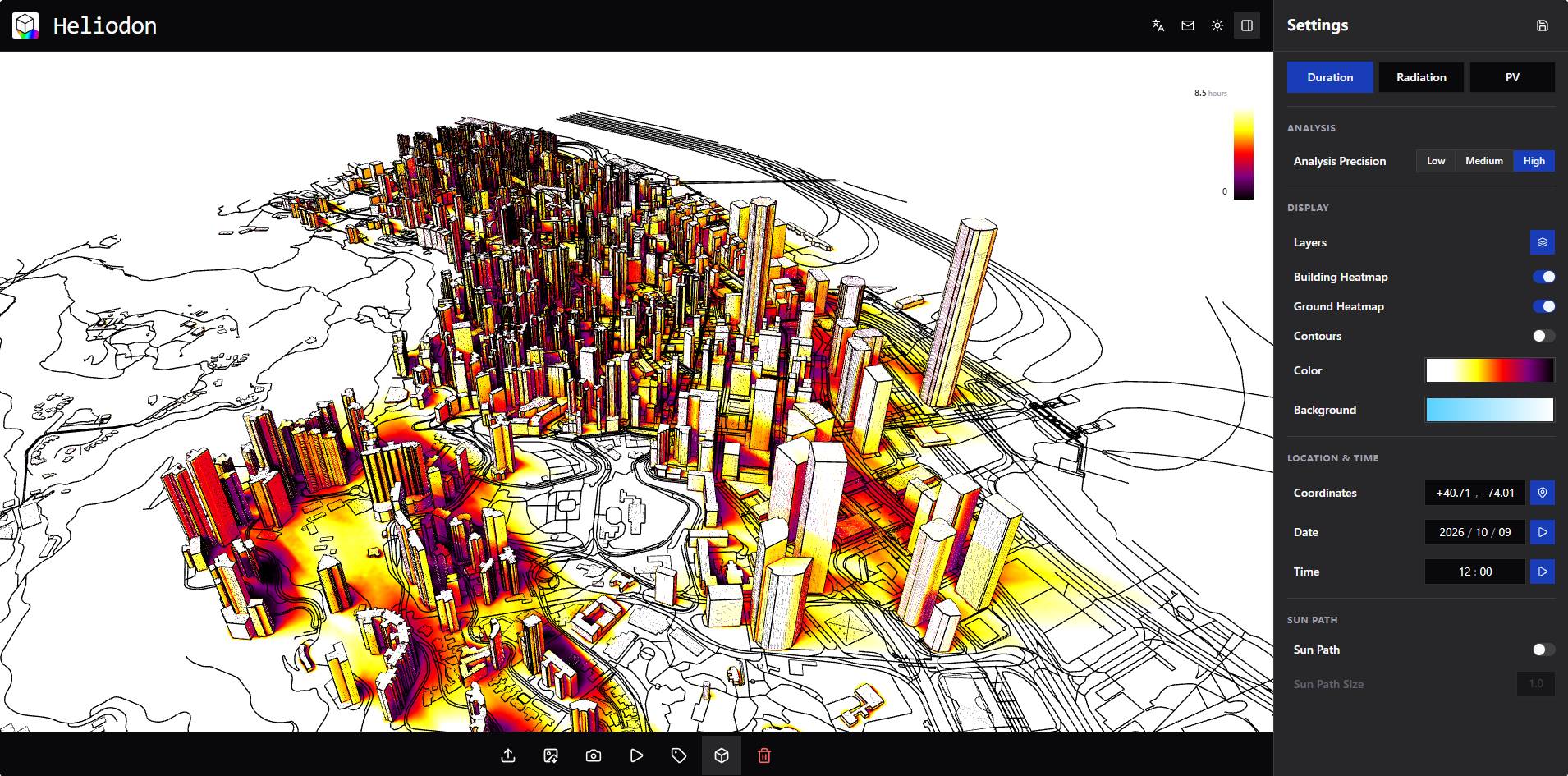
A shadow study answers practical questions about a design: Which façades and courtyards are sunlit in winter? How much shadow does a new tower cast on its neighbours? Where should an entrance, terrace or playground be placed? Because the sun is never in the same place twice, the analysis must run across a day and across the seasons rather than at a single instant.
Typical outputs include:
- Shadow maps for specific dates and hours (for example 21 December at 09:00, 12:00 and 15:00).
- Sunshine-duration heatmaps showing how many hours a surface receives direct sun.
- Solar radiation (plane-of-array) accumulation on roofs and façades.
- Animated sun-path and shadow sequences for presentations.
Why it matters in architecture and planning
- Daylight and comfort: sunlight drives daylight autonomy, glare risk and outdoor thermal comfort.
- Overshadowing and rights to light: many planning authorities require evidence that a scheme does not deprive neighbours of sunlight.
- Urban massing: shadow behaviour is the fastest way to compare massing options on a dense site.
- Solar energy: shadowing is the dominant loss factor for rooftop photovoltaic (PV) systems, so shadow analysis feeds directly into energy yield.
- Landscape and public space: planting, plazas and playgrounds are selected by how they are shaded through the day.
How shadow analysis works
Every shadow study combines three ingredients: a location (latitude, longitude and time zone), a date and time range, and the 3D geometry of the buildings and site. From the location and time the software computes the sun's position - altitude and azimuth - using a solar position algorithm. That position is what a sun path diagram visualises for a whole year. The geometry is then tested against the sun vector to produce shadows and, when accumulated hour by hour, sunshine duration and radiation.
This is closely related to shadow modeling, which covers how the shadow geometry itself is constructed and rendered.
Physical heliodon vs digital shadow analysis
Before computers, architects studied the sun with a heliodon - a physical device that tilts a scale model relative to a lamp to reproduce the sun's path. The technique is still taught in architecture schools, and it is where this tool takes its name. Digital shadow analysis replaces the physical model and lamp with a 3D model and a computed sun path, which makes it far faster to test many dates, times and design options.
Running a shadow study in Heliodon
- Import a model: open a .3dm, .obj or .dae file of your building or city block. Parsing happens locally in your browser.
- Set the location: pick the site on a map so the correct sun path is used.
- Choose a date and time range: step through the day, or run the full year for accumulated results.
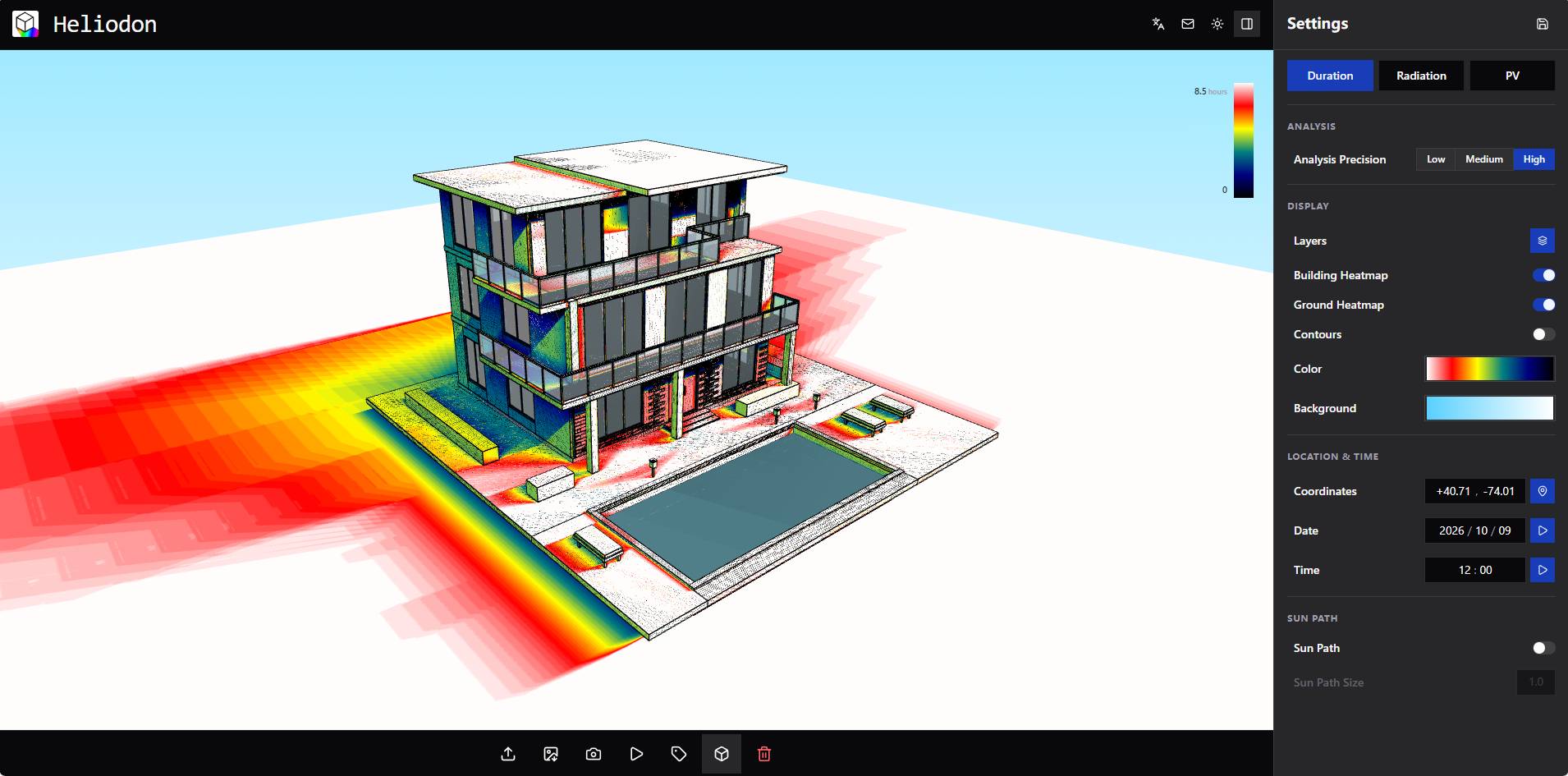
- Read the results: view real-time shadows, sunshine-duration and shadow heatmaps, and solar radiation.
- Export: capture screenshots, record an animation, or export a detailed Excel report.
Because the simulation runs on the GPU in the browser, results update as you move the sun, which makes the tool well suited to early-stage design exploration.
Run an architectural shadow analysis now
Heliodon is free and runs in your browser - no install, no account. Upload a model and study shadows in real time, then estimate PV energy yield, ROI and carbon reduction from the same results.
Launch HeliodonFrequently asked questions
What is architectural shadow analysis?
Architectural shadow analysis is the study of how a building or urban massing casts shadows and receives sunlight over time. It uses the sun's path for a given location and date to project shadows onto the site and surrounding buildings, and is also called a shadow study or sun study.
What is the difference between shadow analysis and shadow modeling?
Shadow modeling is the process of constructing the geometry that represents shadows, while shadow analysis interprets those results - for example sunshine hours, overshadowing of neighbours, or solar access. In practice the two are used together.
Can I run architectural shadow analysis in a browser?
Yes. Heliodon is a free browser-based tool that loads .3dm, .obj or .dae building and city models, simulates the sun path in real time and generates shadow and sunshine-duration results without installing software.
Which file formats are supported?
Heliodon supports .3dm (Rhino), .obj and .dae models, including large-scale city and building models. Files are parsed locally in your browser.